Meskel
MESKEL
Meskel is one of Ethiopia's most spectacular and widely celebrated religious festivals, commemorating the discovery of the True Cross upon which Jesus Christ was crucified. Celebrated on September 27th (or 28th in leap years) according to the Gregorian calendar, this ancient festival has been observed for over 1,600 years and represents a unique blend of Christian faith, Ethiopian tradition, and community celebration that brings together millions of people across the country.
The festival's origins trace back to the 4th century when Empress Helena, mother of Constantine the Great, discovered the True Cross in Jerusalem. According to Ethiopian Orthodox tradition, a piece of this sacred cross was brought to Ethiopia, and the celebration of Meskel became deeply rooted in Ethiopian culture. The name "Meskel" itself means "cross" in Ge'ez, the ancient liturgical language of Ethiopia, reflecting the festival's central Christian symbolism and its profound significance in Ethiopian Orthodox faith.
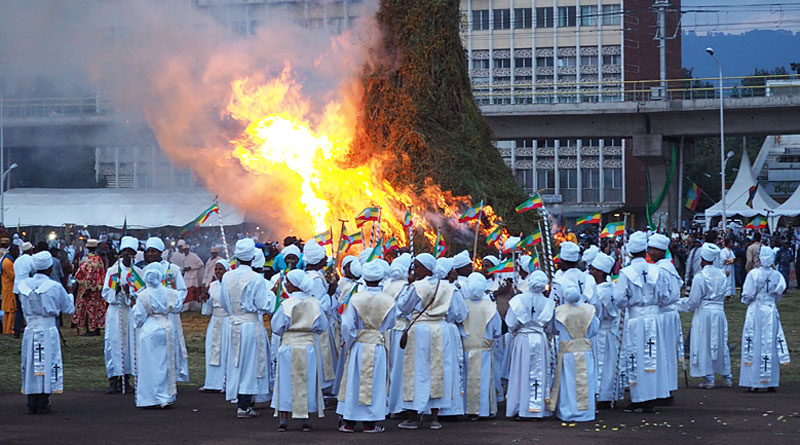
The highlight of Meskel is the spectacular bonfire ceremony known as "Demera," where massive pyramidal structures made of wood and topped with flowers are constructed in town squares and church courtyards across Ethiopia. The largest and most famous Demera takes place at Meskel Square in Addis Ababa, where hundreds of thousands gather to witness the lighting of the towering bonfire. As evening falls, the patriarch or senior clergy blesses the assembled crowd and lights the Demera, creating a magnificent spectacle of flames that can be seen for miles around.
Beyond the dramatic bonfire ceremony, Meskel is a time of joy, renewal, and community bonding. Families and friends gather to share traditional foods, exchange flowers (particularly the yellow Meskel daisy that blooms during this season), and participate in singing and dancing that continues late into the night. The festival also marks the end of the rainy season and the beginning of the harvest time, making it a celebration of both spiritual and agricultural abundance. The ashes from the Demera are considered blessed and are often used to mark crosses on foreheads, symbolizing protection and spiritual renewal for the coming year.